A marriage contract that accidentally preserved an ancient library edict
A 127 CE papyrus from Oxyrhynchus, freshly digitized by the Bodleian, carries a dowry list on one side and — on the other — the only surviving administrative edict from the Library of Hadrian in Alexandria.
On April 19, 127 CE, a professional scribe named Diogenes sat down in Oxyrhynchus — a mid-sized city in the Egyptian desert roughly 100 miles south of modern Cairo — and wrote out a marriage agreement between a man named Sarapion and the father of a young woman named Thais. The contract was duly submitted to the local archives for registration, then at some point declared obsolete and tossed aside as scrap.
That discard was one of the more consequential accidents in the history of ancient record-keeping.
A clerk named Apollonios picked up the used papyrus and flipped it over. On the blank side, he copied out two urgent official proclamations for his colleague Horion. Then he set it down, and for roughly 1,760 years nothing happened. Around 1890 the document was excavated near the Kharga Oasis in Egypt's Western Desert and purchased by Oxford papyrologists Bernard Grenfell and Arthur Hunt. It eventually entered the Bodleian Library at Oxford, where it sat under the shelfmark MS. Gr. Class. a. 9 (P).
In March 2026, it was photographed in high resolution and published on Digital Bodleian — where anyone can now read both sides. 1
The marriage contract on the front
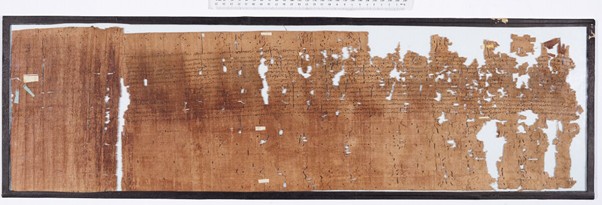
The recto — papyrus terminology for the front face, where fibers run horizontally — is written in exceptionally long lines of Greek. Diogenes laid out a standard Roman-period marriage contract: the names of the parties, the city, the date ("the eleventh year of Emperor Hadrian"), the conditions of the union.
What makes it vivid rather than merely administrative is Thais's dowry list. Diogenes recorded her personal property entering the marriage: "a brooch, a gold necklace set with three green stones, two dresses, and two girdles, one red and the other rose-coloured." 1 Four objects. A small inventory of one woman's material life in second-century Egypt.
The contract also looked ahead to less pleasant possibilities — provisions for divorce ensuring each party could reclaim their property, and inheritance arrangements if one partner died. The stated aim, in the formal language of such agreements, was securing "a blameless and harmonious marriage." Whether Thais and Sarapion achieved that, the papyrus does not say.
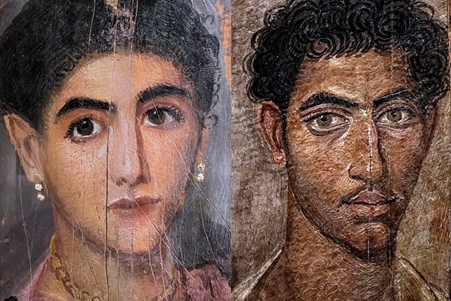
A hypothetical couple from 2nd-century Egypt. Left: Louvre N 2733 3 (circa 150 CE). Right: Manchester Museum (circa 80 CE). Both via Wikimedia Commons, CC BY-SA 4.0.
The memo on the back — and what it contained
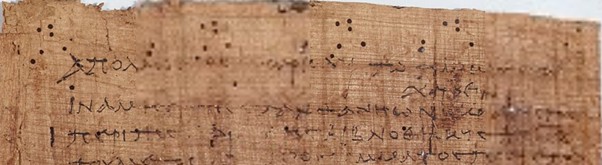
Sometime after the marriage contract was discarded, Apollonios turned it over and wrote a memo. He was a clerk, and Horion — the addressee — was a colleague. The memo's purpose was to transmit copies of two official proclamations issued by the Prefect of Egypt.
The first, dating to around March 127 CE, announced an administrative overhaul. The Roman authorities had identified problems — irregularities or tampering — in how legal documents were being stored and accessed in Alexandria. The existing central archive, known as the Nanaion, would continue operating, but a second repository was being added alongside it: the Library of Hadrian.
Under the new rules, every contract drawn up anywhere in Egypt had to be processed at a central administrative office called the katalogeion (Catalogue), where scribes would organize documents into composite indexed rolls. Abstracts were to be prepared in two copies and sent to both the Nanaion and the Library of Hadrian simultaneously — a dual-registration system designed to prevent alteration and ensure accuracy. Custodians of the Central Archives were forbidden to lend or display any document without explicit authorization from the director of the Library of Alexandria. 1
The second proclamation, issued a few months later in August 127 CE, showed that the first had not been universally welcomed.
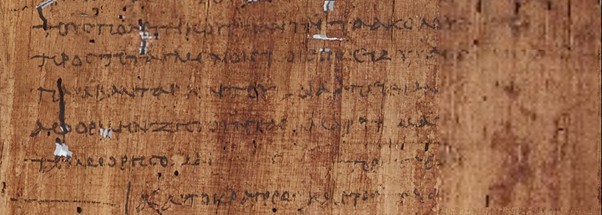
The Prefect made it explicit: all librarians and archivists "who may dare to violate the new rules, whether from disobedience or any illicit reason," faced severe punishment. 1 The phrasing implies what compliance reports almost never say out loud: that someone, somewhere, was already ignoring the first order.
Peter Toth, Curator of Greek Collections at the Bodleian, suggests it may have been precisely this threat that prompted Apollonios to copy the decrees for Horion in the first place. By writing them on the back of a discarded marriage contract, Apollonios was practicing ordinary bureaucratic economy — using available material rather than wasting fresh papyrus.
Why it matters that both sides survived
One papyrus fragment. Two historically independent documents. Neither face was written with any awareness of the other, and neither was intended to survive.
The marriage contract gives us Thais — her dowry, her legal standing, her city's administrative streets. Papyri like this are the primary evidence for how ordinary women in Roman Egypt owned and transferred property. There is no literary source for a gold necklace set with three green stones. There are only documents like this one.
The memo on the back, meanwhile, is something rarer still. The Library of Hadrian is mentioned in other ancient sources, but the administrative mechanics of how it operated — the dual-registration system, the prohibition on unauthorized lending, the role of the katalogeion — survived here because Apollonios needed something to write on. As Toth describes it, the clerk "unintentionally preserved a unique witness to the administrative reforms governing the central archives of second-century Alexandria." 1
The entire document is, as Toth puts it, "a striking example of how an everyday document, once discarded as waste, was recycled — and ultimately preserved a unique historical source." 1
MS. Gr. Class. a. 9 (P) is one of 15 papyrus fragments digitized as part of the Bodleian's two-year "We Are Our History" project, which set out to surface overlooked voices in the collections — women, children, enslaved people, workers on the social margins of ancient Egypt. The digitization made these fragments available through Digital Bodleian's IIIF viewer, meaning the high-resolution images can be loaded into any compatible research platform.
Reading it yourself
The complete digitized papyrus — both recto and verso, with zoomable high-resolution images — is freely accessible through Digital Bodleian:
No registration required. The IIIF manifest is open, so the images can also be pulled into external viewers. The Bodleian's curatorial blog post by Peter Toth, linked above, walks through the key passages on both sides and provides the scholarly context for the Library of Hadrian edict.
Add more perspectives or context around this content.